Reflections from the Glenthorne Community Grassland
I’m often asked some version of the question: Did the Grassland project succeed or fail?
The answer is both. Completely and unapologetically both.
From the outset, the Glenthorne Community Grassland was enormously ambitious. It set out to reimagine what urban biodiversity could look like when approached through both landscape architecture and restoration ecology. Our aim was to create a living, self-organising, self-repairing, and aesthetically rich grassland ecosystem; not a garden or a static planting, but a living system capable of sustaining itself through time.
We tried to do it at scale, in the real world, bringing together different institutions and a broad group of people. Coordinating across those worlds was never simple. Projects like this depend on persistence and shared intent as much as on formal structures of support. Endorsement opens the door, but it’s people (their curiosity, problem-solving, and care) that carry the work forward, and I’m deeply grateful to everyone who contributed in those ways.
The resources were modest, but the ambition was not. Every part of the vegetation was tested, measured, and learned from.
At its heart, the project set out to see whether a grassland could function as a true ecosystem while still being shaped through design, through deliberate choices about placement, boundaries, interpretation, and storytelling, and collaboration across disciplines and stakeholders.
In South Australia, we know how to make dense, tidy, native tussock-based grasslands. They’re dependable, but simple. Glenthorne tried something that hasn’t been proven: to build a wildflower-rich, ever-changing community of plants, a system that could organise, repair, and adapt itself over time.
Seeing value in “messiness”
Healthy grasslands aren’t uniform. They rely on what ecologists call heterogeneity: in plain terms, variety. This includes diversity in species, forms, and functions, as well as the open spaces between tussocks. Those inter-tussock gaps are where most of the action happens: seeds germinate, insects forage, lizards bask. To the eye, these areas can look scruffy, but they’re what make the whole system work.
That’s what we designed for. Instead of suppressing variation, we tried to create it using a mix of site preparation techniques (chemical fallow, solarisation, topsoil removal), different seed mixes (grass-only, chenopods with grasses, and wildflower-rich blends), and time itself as our main tools.
What emerged
Across the site, the system has shown real promise. In many areas native species have established strongly and begun forming young, self-assembling communities. Our spring 2024 survey recorded close to a million individual plants; an extraordinary pulse of life generated from seed and soil preparation alone.
The dry spell of 2024–25 tested that progress, reminding us that every living system has limits. While the establishing parts of the grassland took a hit, many areas held steady, and we know for certain that the site now supports hundreds of thousands more native plants than it did before, a clear shift in the ecological baseline. The project was never about reaching an end point; it’s about understanding and working with the dynamics of a living system.
Rethinking what success looks like
If success means botanical purity, almost every restored or remnant grassland will fail. But if success means creating the conditions for native life to persist and spread, the story becomes far more interesting.
A mix of native and non-native species can still offer real ecological gains — nectar, seed, shade, and structure for insects and birds. Tens of thousands of wildflowers among weeds are still tens of thousands of opportunities for pollinators.
Once we accept this then the key becomes the trajectory, not the purity. Grasslands are living systems that evolve through time. Our role is to guide them gently, not hold them still.
The tools we have
To guide the system, we first need to ask the right questions:
Which non-native species can coexist, and which must be removed?
What does success look like in a landscape where weeds are part of the reality?
How do we reduce target weeds over time, rather than in a single season?
There’s a whole toolkit to work with: pre-emergent, broadleaf-selective and grass-selective herbicides; over-sowing; slashing and mowing with a catcher; hand-dabbing; and, occasionally, burning or perhaps even short-duration (“crash”) grazing.
Each tool has its moment and its cost. Pre-emergent herbicide, for example, can suppress weeds but also weaken natives if followed by a harsh season. Well-timed slashing might halve the number of viable oat seeds that drop each year and repeating that again could reduce the seed drop to a quarter of its original size.
Used well and at the right time, these actions nudge the system toward balance. Used too often or too broadly, they can set it back. The art is in timing, selectivity, and restraint.
In that sense, the project has been both a success and a failure. It succeeded in shifting what’s possible: proving that a diverse native grassland can establish, persist, and evolve under real-world conditions. But it also revealed where our methods fall short. Some patches, especially on the heavy black cracking clays, remain highly weedy and difficult to establish. Those areas remind us that site conditions, resourcing, and time all shape outcomes. The value lies not in perfection, but in what we’ve learned by trying.
It’s not a finished picture. It’s a living process. And perhaps the real measure of success is that we’ve built something that keeps teaching us how to listen, adapt, and let life unfold on its own terms.
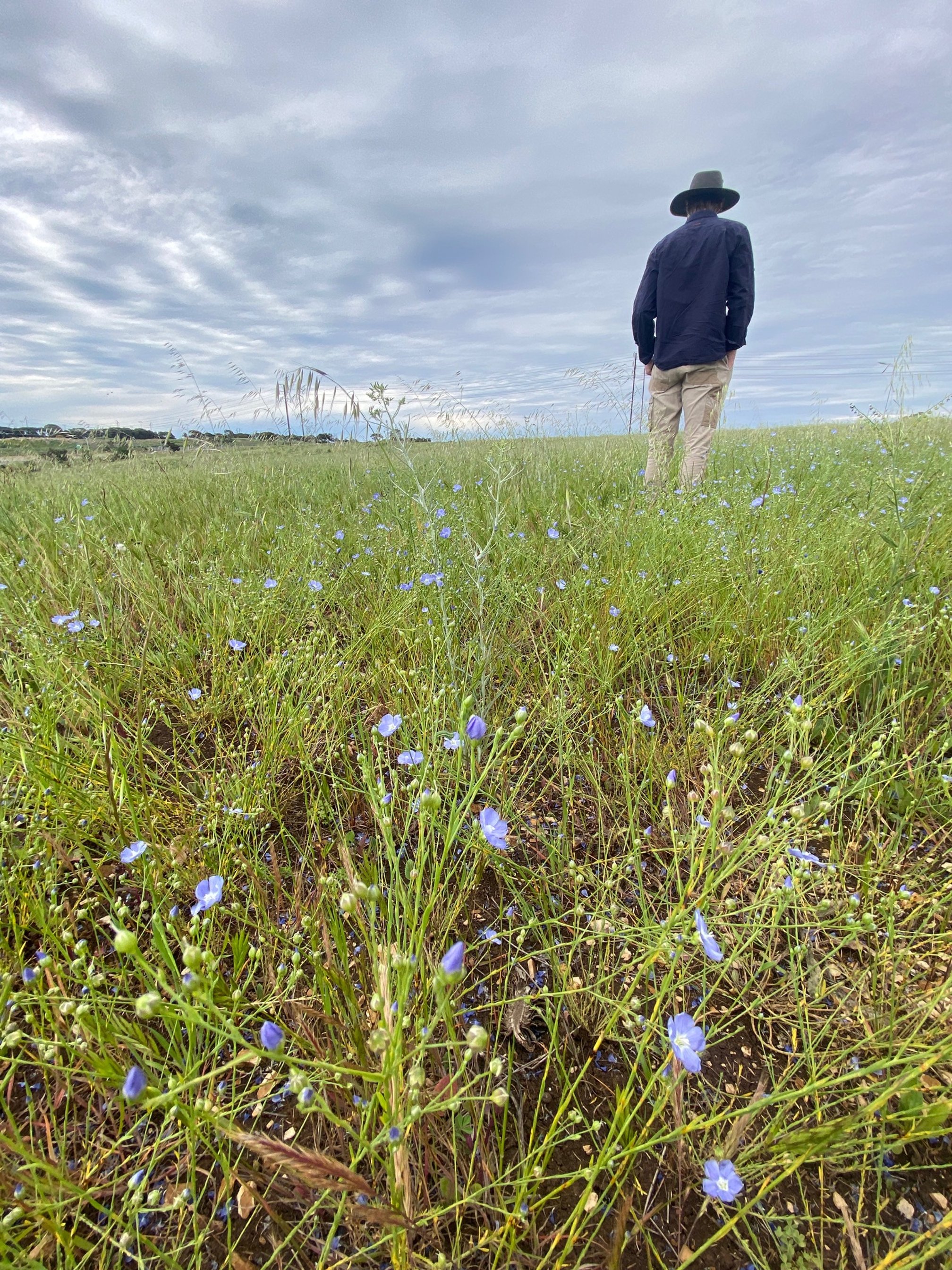
Photograph by Scott Hawken