How satellites can help us understand whether grassland restoration is working
Grasslands change with the rhythms of the seasons, greening up, growing and eventually drying off as conditions change. This seasonal rhythm, known as phenology, can also leave a signature visible from space.
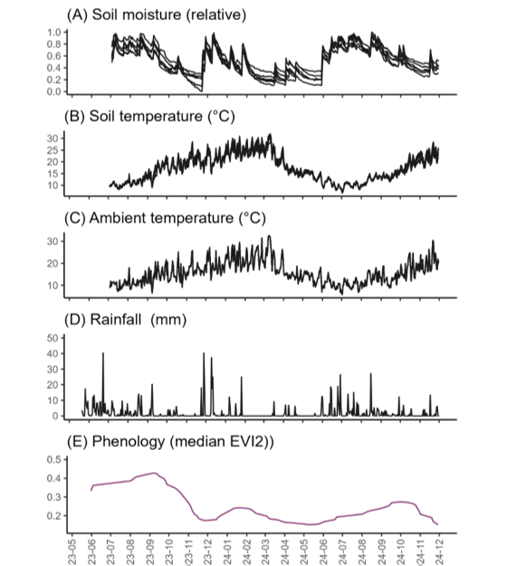
We used freely available Sentinel-2 satellite imagery to track these seasonal patterns across restored, unrestored and remnant native grasslands in South Australia. Rather than simply looking at how green a site appeared on a single day, the study followed changes in vegetation through time and compared characteristics such as the length and peak of the growing season.
One of the clearest findings from our study published in Applied Vegetation Science (doi: 10.1111/avsc.70054) appears somewhat counterintuitive at first: greener didn't necessarily mean better. At the peak of the growing season, unrestored grasslands dominated by non-native plants were considerably greener than restored and remnant native grasslands. Restored grasslands, by contrast, displayed peak greenness much closer to remnant native grasslands. Differences in the length of the growing season were less clear.
The research shows how satellite imagery can complement on-ground monitoring by allowing changes in grassland vegetation to be followed across both space and time. As freely available Earth-observation data become increasingly accessible, these tools offer practitioners another way to understand how restored landscapes are changing.